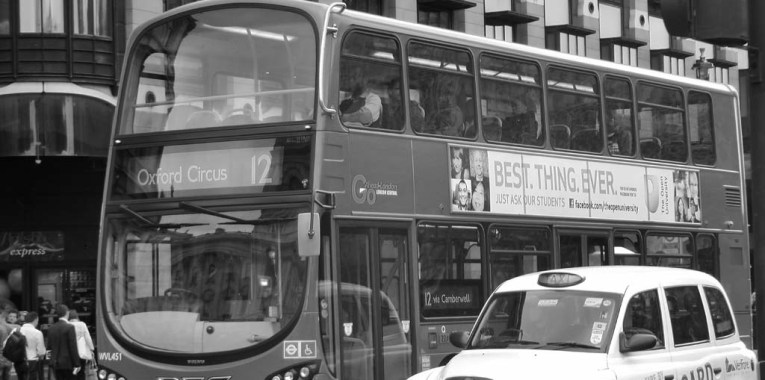
Buses, cars and taxis run all over London providing vital transport for more than 8 million people, but such a massive number of vehicles release large quantities of invisible pollutants into the air.
Nitrogen dioxide (NO2) and particulate matter (PM10 and PM 2.5) make up the majority of the contaminants, predominantly caused by domestic emissions and, above all, traffic fuels.
Dr Gary Fuller senior lecturer in air quality measurement at King’s College London and leader of the London Air Quality Network, said:
“We have been monitoring air quality in London since 1993. During this time we have seen a decrease in some air pollutants but others have being rising. In terms of PM2.5 we are just about meeting the EU levels and compared to other cities in Europe we have a much better situation.
“Nitrogen dioxide still remains a big problem in London. We were supposed to meet the European levels by 2010 and now the final term is 2020, but looking at the current levels of NO2 and the number of diesel cars in London- it is unlikely that we’ll be able to achieve this target”.
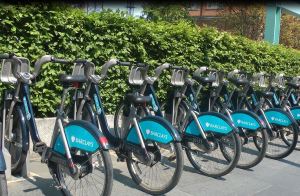
In 2008 local authorities introduced a Low Emission Zone to discourage from using most polluting diesel vehicles and in 2o10, mayor Boris Johnson and Transport for London announced the launch of new charging points in the city and the delivery of around 1000 electric vehicles by 2015.
However, Jenny Bates from Friends of the Earth said: “Local authorities aren’t doing enough. Congestion charging and LEZ are already something but to save our city we need to do much more than that. Closing roads instead of opening new ones, giving people incentives to buy new electric vehicles and providing efficient public transport.”
Jonathan Visscher, media manager at the Society of Motor Manufacturers and Traders said that new alternative fuelled and electric vehicles are already on the market and that consumers need to be encouraged to buy them.
“European targets are really tough to achieve but cutting down carbon emissions is a problem that manufacturers take very seriously” he says. “We all play a role in this; manufacturers producing new diesel, petrol and alternative fuelled vehicles, government giving people long-term incentives to buy them and consumers getting interested in the new products.”
However, while waiting to see new electric vehicles on London’s roads, air pollution’s levels remain high.
“What happens with air pollution is sometimes unpredictable” said Mr Fuller “If you look at the tests they had done on new vehicles when they were produced you would expect air pollution to decrease consistently but, especially with NO2, we’re not seeing that in London”
 Jenny Jones, who proposed the motion, said:
 Richard Tracey, member of the Transport Committee for the Conservatives at the London Assembly, said:
 Munrad Qureshi, chair of the environment committee at London Assembly, said:
 Stephen Knight, chair of Economy committee, commented:
 London, capital of air pollution
